
Amphibian Aesthetics at Ishara House, Kochi 13 December 2025 – 31 March 2026
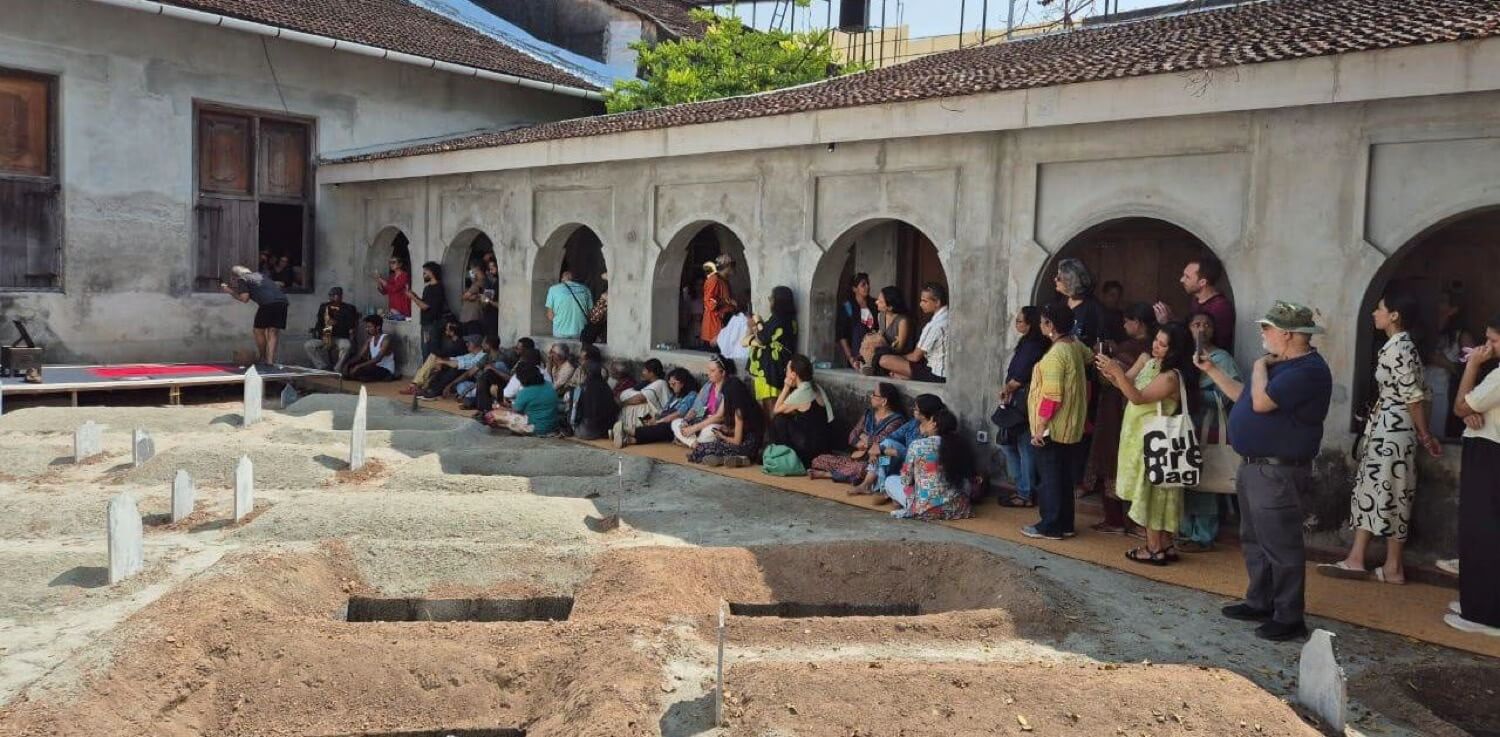
- Ishara Art Foundation opened the Ishara House and its inaugural exhibition Amphibian Aesthetics in Kochi on 13 December 2025 with a weekend of extensive
- Amphibian Aesthetics examines the role of adaptability, intersectionality and shared vulnerability in times of escalating geopolitical crises, climate collapse, and
- The exhibition features 12 artists and collectives from India including Appupen, Shilpa Gupta, Zahir Mirza, Midhun Mohan, Shanvin Sixtous, Ratheesh T, Kabir Project, White Balance and City As A Spaceship (Dr Susmita Mohanty, Rohini Devasher, Sue Fairburn and Barbara Imhof), alongside international artists including Rami Farook, Michelangelo PistoleGo, and Dima Srouji from the UAE, Italy and Palestine
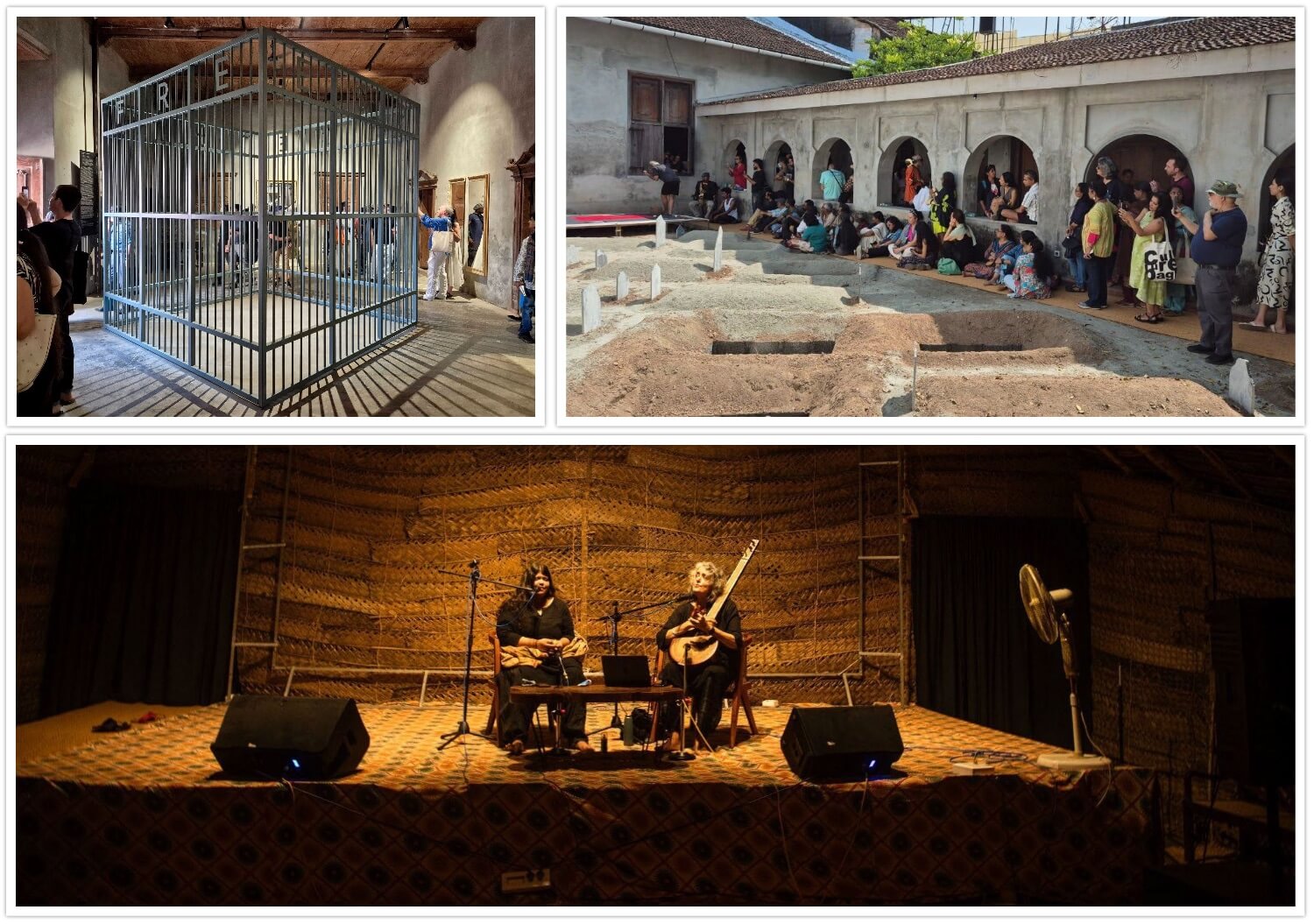
December 2025: Ishara Art Foundation opened the Ishara House and its inaugural group exhibition titled Amphibian Aesthetics within the historic Kashi Hallegua House, in Kochi, Kerala on 13 December 2025. The opening received 3,000 visitors including artists, curators, patrons, leading art critics and members of the general public, with the daily footfall amounting up to 4,500 since the exhibition launch.
The opening included the inauguration of Amphibian Aesthetics with remarks by Smita Prabhakar (Founder and Chairperson of the Ishara Art Foundation), Riyas Komu (Artistic Director of Ishara House and Co-Founder of Aazhi Archives), Sasha Altaf (Director of Ishara Art Foundation) and Sabih Ahmed (Projects Advisor at Ishara Art Foundation), followed by a curatorial walkthrough.
The opening weekend also included a public programme across Kashi Hallegua House and URU Art Harbour, in which Riyas Komu, the curatorial advisors and artists, and a line-up of guest speakers offered insights into how art and architecture respond to the ecological, social and cultural precarities that mark our current age.
At the exhibition opening, White Balance staged Gopalan Solo, a performance that unfolded as a powerful theatrical response to a time marked by violence and dehumanization. On opening night, a panel discussion entitled Amphibian Aesthetics: Art in the Age of Precarity set the stage for ‘amphibian aesthetics’, the philosophical proposition at the heart of the exhibition, with Riyas Komu, Professor C. S. Venkiteshwaran, Professor M. H. Ilias and Professor Amrith Lal, moderated by Sabih Ahmed.
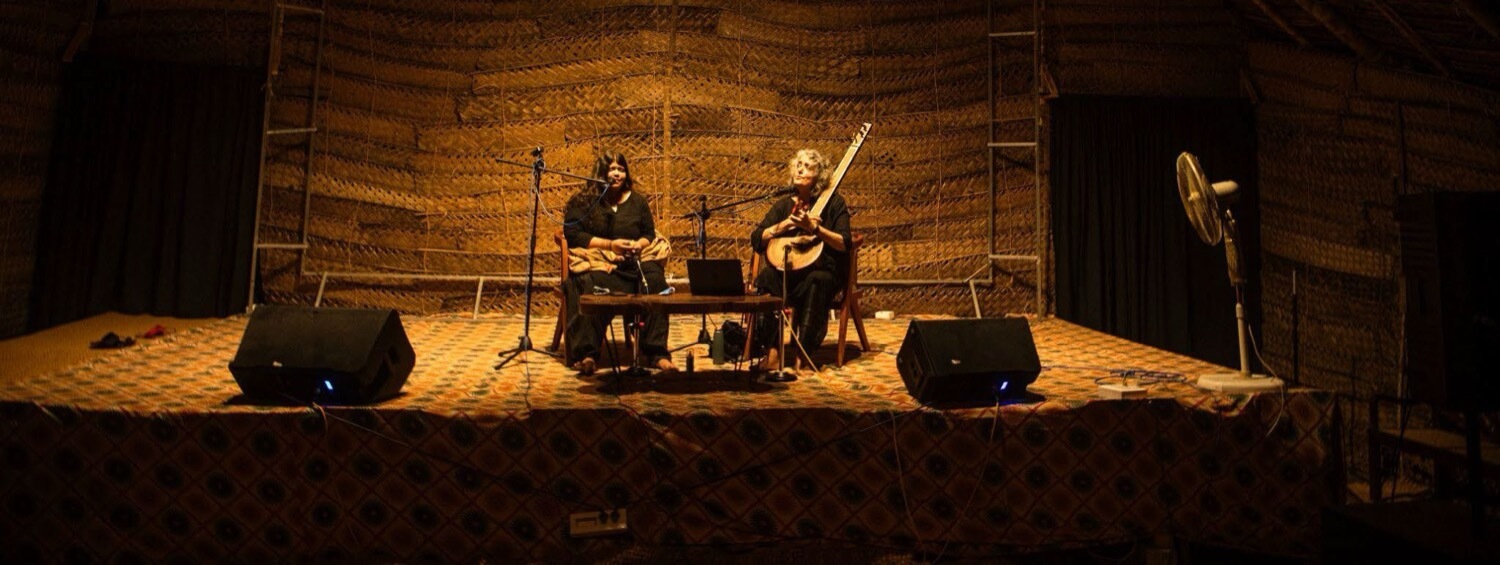
On 14 December, Amphibian Aesthetics: Architectural Imaginaries, a session by Dima Srouji moderated by Anuj Daga, explored how art and architectural practices mould, morph and move through historical exigencies. In the panel discussion Ecology, Migration, and Spirituality, speakers James Onley, Dr. Varuni Bhatia and Dr. Susmita Mohanty and moderator Professor M.H. Ilias discussed how we sense, narrate, and imagine life in a time of climate collapse, migratory displacement, and spiritual search. Shabnam Virmani of Kabir Project, accompanied by Shreeparna Mitra, presented Akath Kahaani Prem Ki: The Untellable Tale of Love, a music performance weaving together poems and insights from Kabir and Sufi wisdom traditions.
Amphibian Aesthetics emerges from the urgencies of precarity in the Anthropocene – climate collapse, displacement, extinction and hyper-capital – where questions of survival and radicality become inseparable from artistic practice. The exhibition unsettles familiar binaries of East/West, tradition/modernity, embracing entangled, rhizomic ways of thinking that refuse fixed hierarchies.
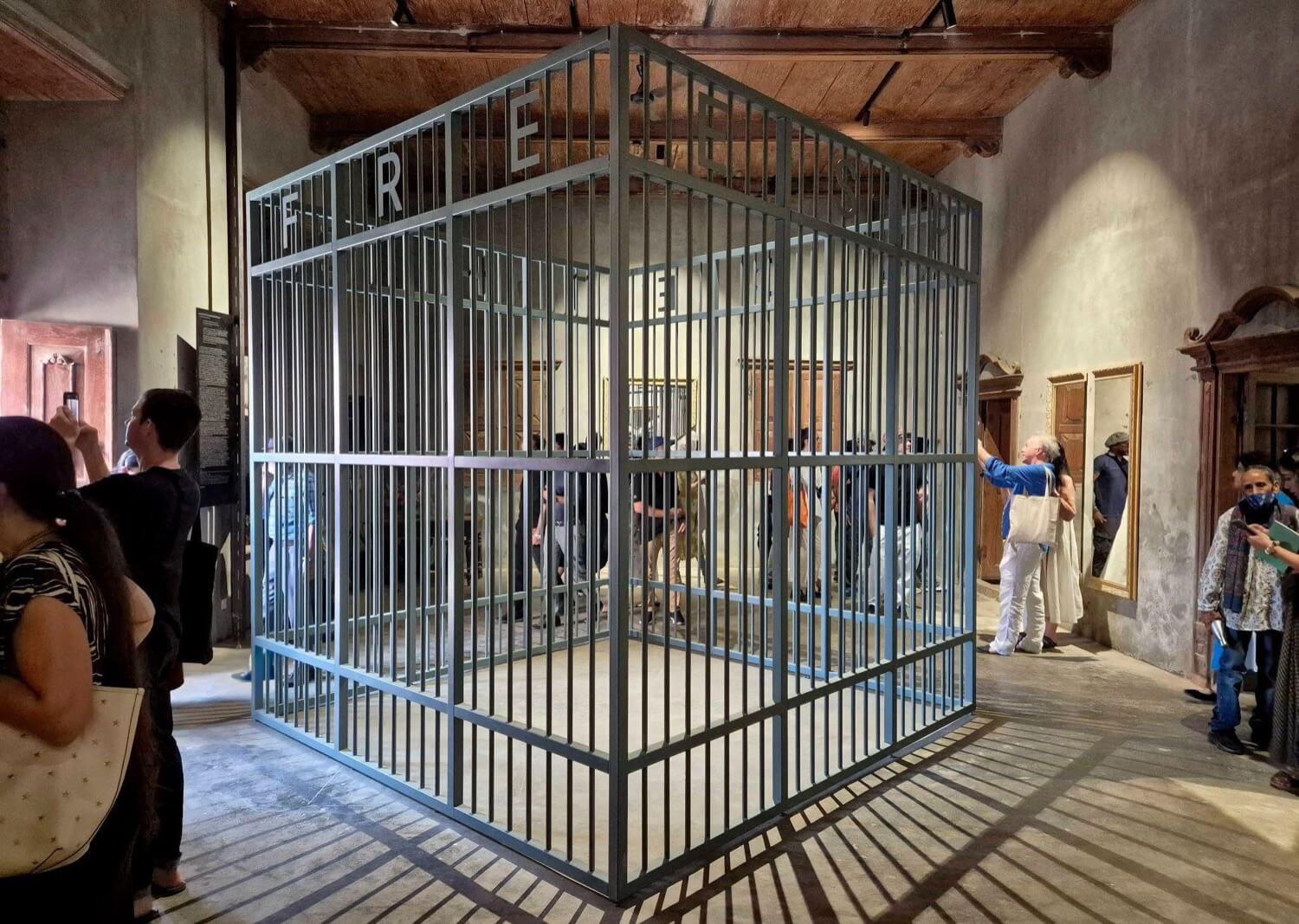
Amphibian Aesthetics features works by 12 artists including Appupen, Rami Farook, Shilpa Gupta, Zahir Mirza, Midhun Mohan, Michelangelo PistoleGo, Shanvin Sixtous, Dima Srouji, Ratheesh T., Kabir Project, White Balance and City As A Spaceship (CAAS) (Dr Susmita Mohanty, Rohini Devasher, Sue Fairburn and Barbara Imhof).
Talking about Amphibian Aesthetics, Artistic Director of Aazhi Archives and co-founder of the Kochi-Muziris Biennale, Riyas Komu says, “Amphibian Aesthetics (AA) continues the long-term inquiries offered in the metaphors and movements along and across the sea with the voyage of artists, curators, writers, critics and scholars at Aazhi Archives (AA), presented by Ishara House. The exhibition offers frames to think through the promises of the planet towards imagining ecologies that demand amphibious modes of thinking and being. Emerging from specific interest in Kerala and Indian Ocean regions, AA converges academic research with contemporary art practice, to develop art projects and knowledge missions that flow towards people.
Amphibian Aesthetics is an attempt to contemplate upon new space-times in art and research to collaboratively survive our fluid futures.”
Smita Prabhakar, Founder and Chairperson of the Ishara Art Foundation, says: “The Ishara House and its inaugural exhibition, Amphibian Aesthetics, represent a significant step forward in the Foundation’s journey to expand its scope geographically and curatorially. These projects solidify the Foundation’s standing as a truly global institution that creates generative dialogues between South Asian and international contemporary art.”
Kashi Hallegua House, the main site of the Ishara House project, was built more than 200 years ago in the historic Jewish quarter of Mattancherry, Kochi, Kerala. The house now serves as an exhibition space and is a hub for contemporary art. Mattacherry continues to be populated with people who migrated from across the world throughout its history.
Ishara House is supported by Alserkal Avenue, in association with Galleria Continua. Project partners include Aazhi Archives and URU Art Harbour.


For more information on the exhibition, please visit ishara.org and follow them on social media @isharaartfoundation
Ishara House Address: Kashi Hallegua House, Jew Town, Fort Kochi – 682002
Dates: 13 December 2025 – 31 March 2026
Timings: Monday to Sunday, 10:30 AM – 7:00 PM
*Please check www.ishara.org for updates prior to planning your visit
For further information, please contact:
Menaka Mahtab
E: [email protected] M: +91 9830043238
Ishara Art Foundation
Ishara Art Foundation was founded in 2019 as a non-profit organisation dedicated to presenting contemporary art of South Asia. Located in Dubai, the Foundation supports emerging and established practices that advance critical dialogue and explore global interconnections.
Guided by a research-led approach, Ishara realises its mission through exhibitions, onsite and online programmes, education initiatives and collaborations in the UAE and internationally. The Foundation facilitates exchange between South Asian and international artistic networks that include museums, foundations, institutions, galleries and individuals.
The Ishara logo, a synthesis of a square and circle, is based on an ideogram by Zarina to convey the word آﺳﻣﺎن (‘Aasman’), sky. It forms one of 36 images from ‘Home is a Foreign Place’ (1999), a work in the collection of Ishara’s Founder and Chairperson, Smita Prabhakar. Ishara signifies a gesture, a signal or a hint, and is a word common to several languages including Arabic, Persian, Hindi, Bengali, Swahili and Urdu.
Ishara Art Foundation is presented in partnership with Alserkal. www.ishara.org
Smita Prabhakar
Smita Prabhakar is an entrepreneur, collector and art patron who has been based in the UAE for over four decades. She is the Founder and Chairperson of the Ishara Art Foundation. Smita is also a member of the International Acquisitions Committee at Tate Modern (London), the Middle Eastern Circle of the Guggenheim Museum (New York) and the Peggy Guggenheim Collection (Venice). Smita’s collection, The Ishara Art Foundation and The Prabhakar Collection, focuses on South Asian contemporary artworks that reflect diverse voices and shared histories from across the region. She has supported the V.S. Gaitonde exhibition, ‘Painting as Process, Painting as Life’ in New York and Venice in 2015-6, a workshop around Shilpa Gupta’s artwork, ‘For, In Your Tongue, I Cannot Fit,’ organised at the Kochi-Muziris Biennale 2018, and the seventh and eight editions of the Colomboscope Festival in 2022 and 2024.
Aazhi Archives
Aazhi Archives, a collective of artists, curators, writers, critics and scholars, has organised shows and workshops that probed into the cosmopolitan histories and maritime pasts of Kochi region. These engagements also involved interactions between historians and artists that delved into tangled histories, residual presents and potential futures of the subcontinent with specific interest in Kerala and Indian Ocean regions. With the mission Art+Knowledge+People, AA links cutting edge academic research with contemporary art practice, to
develop art projects and knowledge missions that connect with people. The project considers people as the centre, as repositories and protagonists of history, as well as destinations and custodians of knowledge that is produced in the process.
Riyas Komu
Riyas Komu is an artist and curator who has exhibited his works worldwide, including at the Venice Biennale. His works – paintings, sculptures, videos, photographs and installations – dwell on a range of subjects that include war, migration, civilisational memories, displacement, violence, betrayal, history, conflict, peace, football and the Indian Constitution.
Komu is the ideator of the Kochi-Muziris Biennale and co-founder of the Kochi Biennale Foundation. He co- curated the first edition of the Kochi-Muziris Biennale in 2012 and subsequently developed the biennale into a multidisciplinary educational project as the Director of Programmes. He co-curated the first International Football Film Festival in India at the Goa International Film Festival and Trivandrum International Film Festival in 2012.
Komu’s critically acclaimed solo projects include ‘Faith Accompli’ (2005), ‘Related List’ (2008) and ‘Holy Shiver’ (2018) which celebrated the art in the Constitution. In 2019, Komu curated the Kondotty Sufi Festival. He is the co-founder of URU Art Harbour, a cultural hub in Mattancherry, Kochi, which promotes artists from the region focused on local culture and maritime history. In 2022, he co-founded Aazhi Archives with a group of academics and scholars which puts the spotlight on Art+Knowledge+People.