
Dates: 9 October – 6 November 2026 Venue: KYNKYNY, Mumbai Address: 4th floor, 20, Gool Mansion,Homji St, Fort, Mumbai, Maharashtra 400001 Timings: Monday – Saturday | 11:00 AM – 6:00 PM (Closed on Sundays) Free Entry Description Although markedly different in their physical and material vocabularies, the practices of Meenal Singh and Sandilya Theuerkauf converge …
Dates: 9 October – 6 November 2026
Venue: KYNKYNY, Mumbai
Address: 4th floor, 20, Gool Mansion,Homji St, Fort, Mumbai, Maharashtra 400001
Timings: Monday – Saturday | 11:00 AM – 6:00 PM (Closed on Sundays)
Free Entry
Description
Although markedly different in their physical and material vocabularies, the practices of Meenal Singh and Sandilya Theuerkauf converge at KYNKYNY, Mumbai, through a shared attentiveness to ecology, abstraction and the processes through which forms emerge and transform. Their work resists the predictability of conventional image-making, instead developing deeply personal modes of working in which material, gesture and perception remain in continual dialogue.
Morphology – the study of form, structure and the ways in which forms develop, provides a productive lens through which to encounter these practices. Here, form is not understood as fixed or predetermined, but as something in a state of continual becoming. This is particularly resonant in relation to the natural world, where growth, decay, adaptation and transformation operate without the rigid binaries through which human experience is often organised.
For Sandilya Theuerkauf, morphology begins with the material itself. His relief works incorporate tree bark, twigs, thorns, dried vines and other organic matter, allowing materials that are often overlooked to become active participants in the construction of the work. Informed by close observation and scientific curiosity, yet equally guided by intuition, Theuerkauf responds to the inherent structures within these materials, their textures, irregularities, densities, colours and organic rhythms.


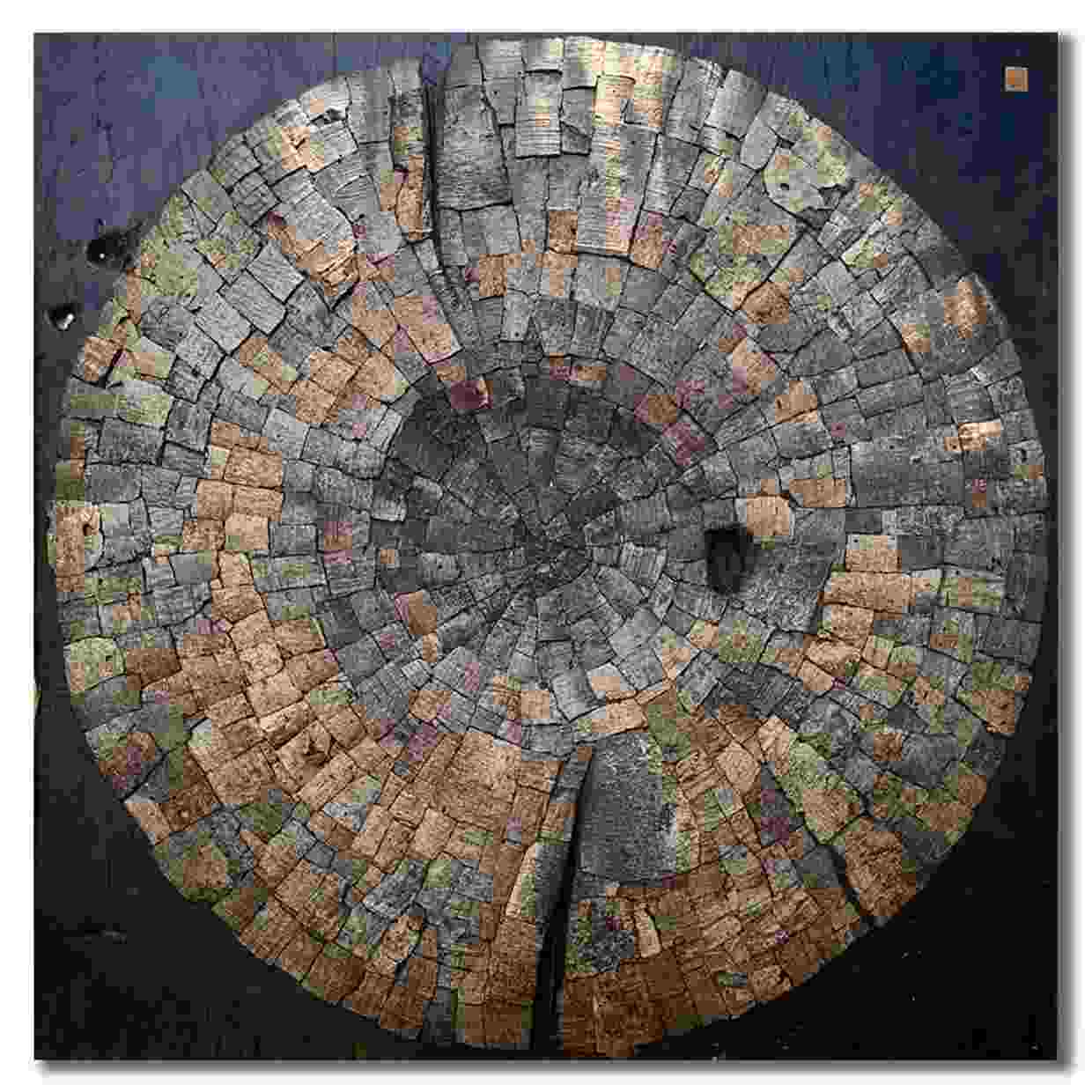
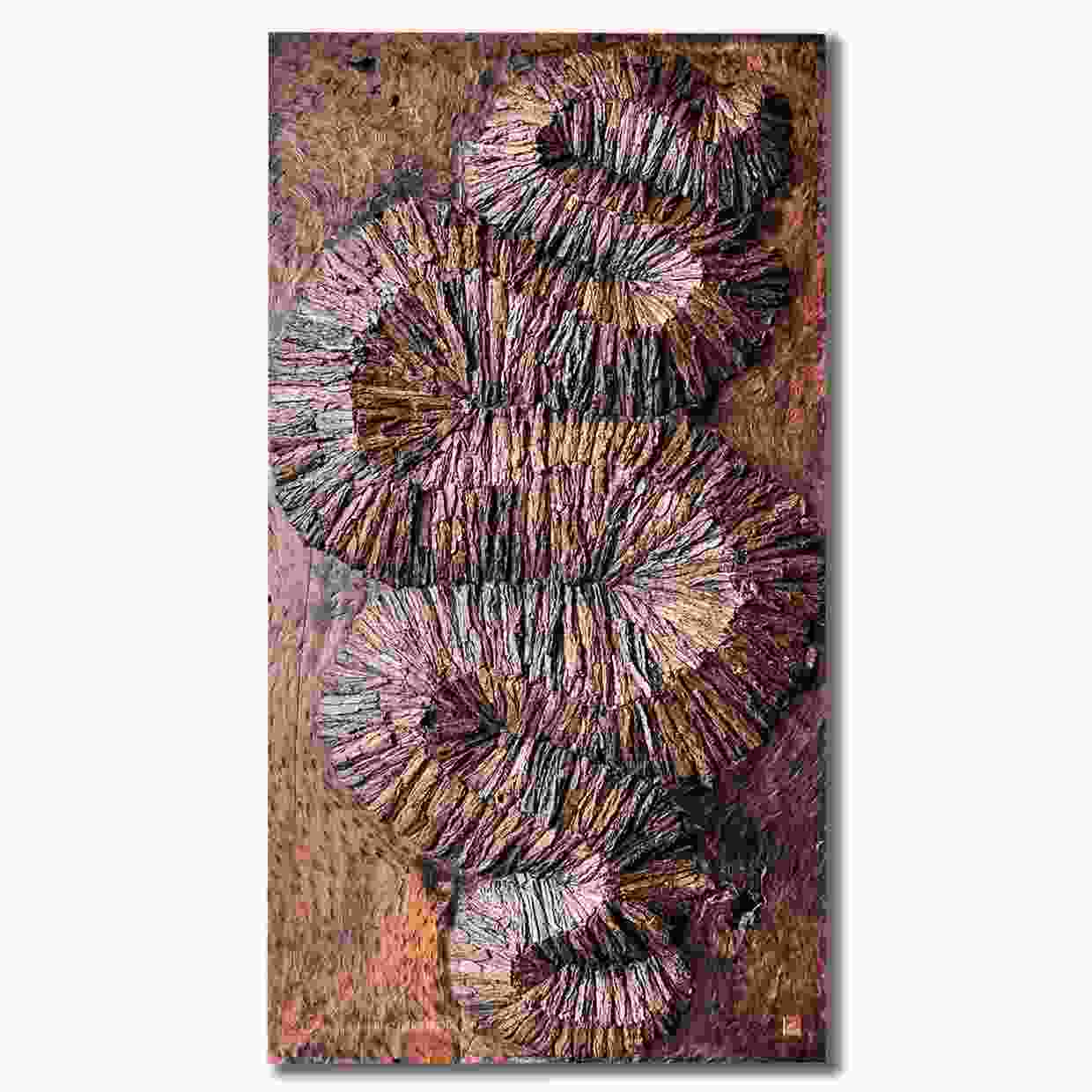
His compositions occupy a space between geometric and organic abstraction. Linear systems, systematic arrangements, repeated marks, dots, textures and solid forms accumulate across the picture plane, generating surfaces animated by rhythm and movement. The works do not describe nature so much as investigate its underlying principles of formation. Organic matter is fragmented, ordered, repeated and reconfigured, becoming a vocabulary through which questions of space, structure and transformation can be explored. In this sense, Theuerkauf’s work is morphological not simply because it employs natural forms, but because it considers how forms come into being, change and ultimately dissolve.
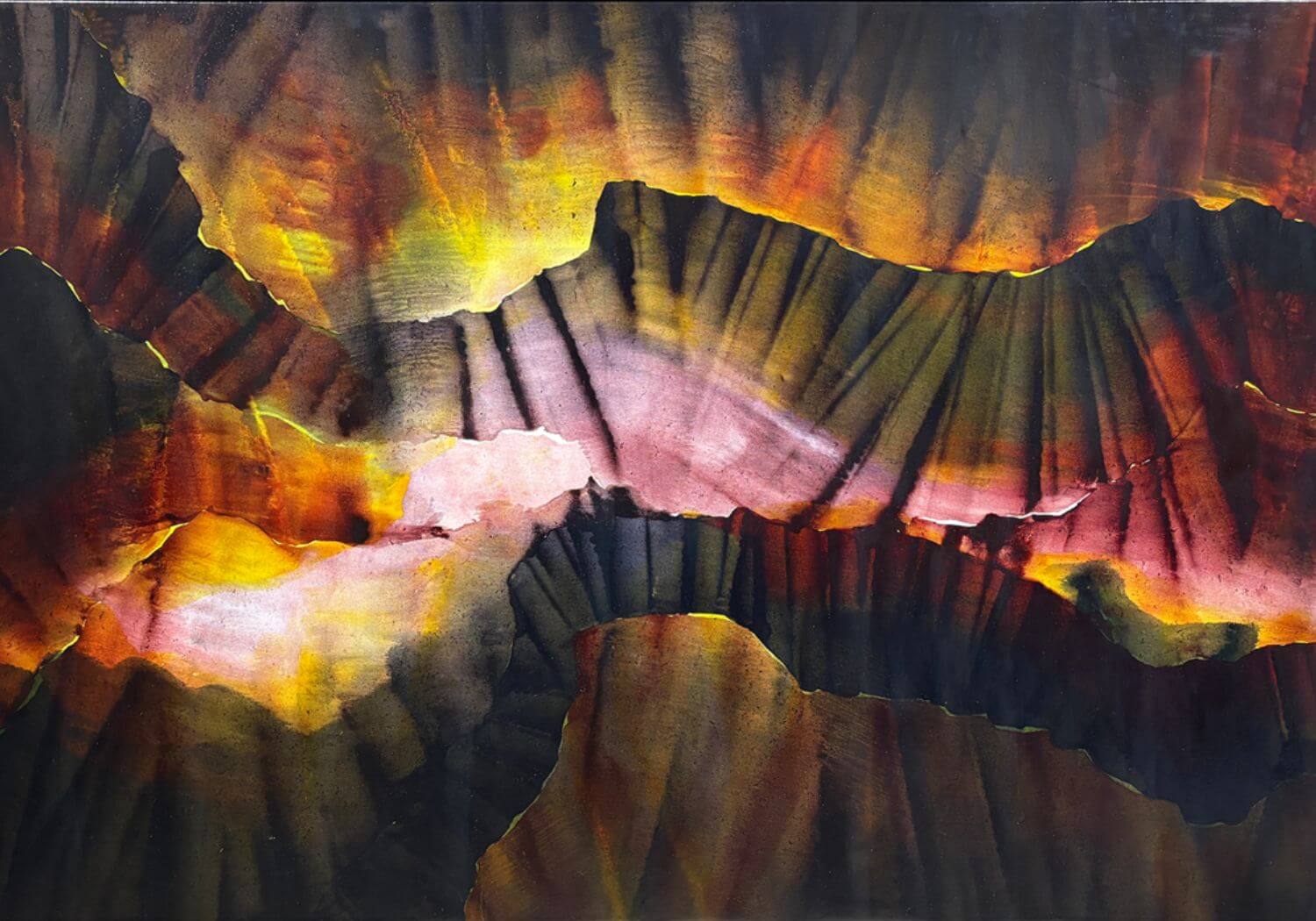
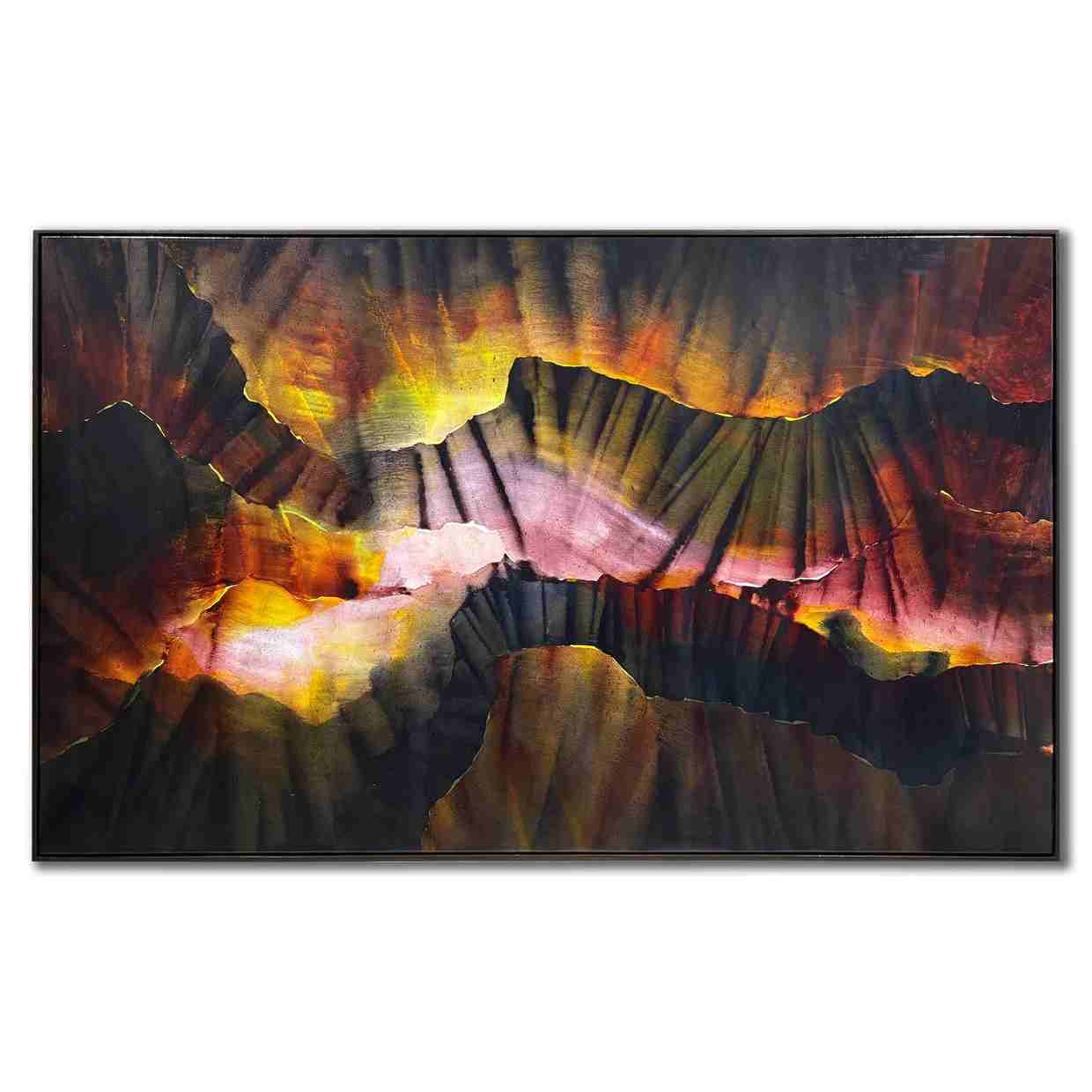
Meenal Singh approaches morphology through a more psychological and chromatic register. Working extensively with oil and pigment, she constructs expansive fields in which colour, memory and perception become intertwined. Her process is not concerned with representing an external landscape, but with giving visual form to an interior and continually shifting terrain.
Paint becomes both material and language. Singh allows pigment to move, pool, drip, dissolve and intersect across the surface, while layering and transparency establish shifting relationships between density, openness and light. Curves, smudges and flowing passages of colour create rhythms that appear simultaneously spontaneous and deliberate. At moments, these formations suggest geological strata, atmospheric phenomena or unfamiliar topographies; elsewhere, they recall patterns and structures encountered in the natural world without becoming representational.
In Singh’s work, therefore, morphology is experienced through transformation. A mark becomes a field; a field suggests a landscape; colour becomes atmosphere; memory becomes form. The image remains in a state of flux, resisting a singular reading and allowing perception itself to become part of the work.
What brings these two practices together is not a shared visual language, but a shared understanding of abstraction as a mode of enquiry. Both artists privilege process over predetermined image, allowing material and gesture to generate unexpected possibilities. Their surfaces become records of a negotiation between intention and accident, structure and intuition, matter and imagination.
The idea of morphology also extends beyond the physical properties of the works to the artists themselves. The act of making becomes a process of reciprocal transformation: as the artists shape their materials, their understanding of themselves and the world is also reshaped. The artwork is consequently not an endpoint, but evidence of an ongoing process of becoming.
Morphology brings these divergent practices into a productive conversation. Singh’s chromatic fields and Theuerkauf’s organic constructions offer two distinct propositions about how form can emerge from experience, material and perception. One moves through colour, memory and the interior imagination; the other through matter, observation and the structures of the natural world. Both, however, remain concerned with the same fundamental question: how does something come into form?
The exhibition proposes abstraction as a space in which that question need not have a fixed answer. Form can accumulate, dissolve, mutate and reconstitute itself. It can be observed, remembered, imagined or discovered. In the work of Singh and Theuerkauf, morphology becomes less a study of what forms are than of how they become.
ABOUT THE ARTISTS
MEENAL SINGH
As an artist, Meenal Singh operates from a point of deep engagement with her process and medium, which is primarily oil-on-canvas. Working not with brushstrokes or palette knives, but the unique flow and behaviour of the pigments themselves, she transforms liquid colours into vast swathes of form and space, emulating imaginary landscapes and abstracted topographies of the mind. Her paintings play with intense colour, texture, transparency, and the visual effects of light and motion, evolving into a distinctly calm and contemplative space.
Meenal’s work evokes a sense of immediacy and proximity – the large frames intend to include and embrace the viewer within the picture-plane rather than the usual inward gaze from an external perspective. Her inspiration is rooted in the translation of emotional experience through the all-consuming process of painterly experimentation. She sees colour as having historical and cultural significance, reflective of multiple meanings in the context of human understanding.
Connecting with her past training and practise as an architect, Meenal’s engagement with structure, volume and solidity comes through visibly. Explaining that her process is bound deeply to self-exploration, she says, “I am still thinking like an architect, as though I am simply facilitating the material and allowing it to do what it does best.”
The field of ecology, and a practical engagement with land and the environment forms an important part of her life. Her paintings reflect subconsciously imbibed learnings from nature, not as direct narratives but as filtered essences, including shapes, patterns, colours, textures, and atmospheres that make up the earth we inhabit.
She graduated from the School of Planning and Architecture, New Delhi and holds a Master of Architecture in Conservation from the Texas A&M University, USA. She followed it with a course in metal sculpture at the Corcoran Museum of Art, Washington DC. Meenal lives and works between her studio in Bangalore and farm in Denkanikottai, Tamil Nadu, where with a community of friends and family, she has been reforesting the land from a lantana infested scrub to a native deciduous forest since 2014.

SANDILYA THEUERKAUF
Sandilya Theuerkauf’s sculptural-relief works are deeply embedded in the experience of nature, both in their material construction and visual form. For him, observing and making is a constant process of learning; his art is fed by the walks he takes in the wilderness and the deliberate attention he pays to all the animate and inanimate elements of a landscape he finds himself in. He celebrates the moment of awareness and communion with nature; the pause, and nowness of being that he chooses to share with viewers, rather than build external narratives.
An artist by intuition rather than by training, Sandilya’s practice revolves around the act of sharing. For him, the material always dictates what he makes. Through his process, Sandilya explores profoundly philosophical questions about life, and his relationship to the land he inhabits. “Is there a way to see, and listen in a deeper way, a more intense way?… Is there a possibility of looking at something without images?… I’m inhibited in my relating to a flower because of all the images {and labels} I have about the flower. Is there a way to relate to it for what it is?”, he asks.
Each sculptural piece offers a meticulous arrangement of vegetal matter, shaped in patterns that play with symmetry and asymmetry, geometric and organic abstraction. In his works with tree-bark, Sandilya brings focus to the intrinsic botanical characteristics of various trees and the textures, colours and type of surfaces that often go unnoticed in the blur of urban living. His other artworks explore dimensional formations of twigs, thorns, seeds, dried vines and other natural material that he collects.
Sandilya attributes his perception and knowledge to his growing years in Kerala in the midst of nature, followed by his professional experience over time as an environmental educator and restoration ecologist. With his foray into the world of art, his objectives continue to be rooted within a personal narrative of learning and sharing.
He currently lives and works in a farm on the outskirts of Bangalore.
ABOUT KYNKYNY :
KYNKYNY Art Gallery, founded in 2004 by Namu Kini and Vivek Radhakrishnan, is a leading contemporary art gallery based in Mumbai and Bangalore. With over 22 years of experience, the gallery is known for its thoughtful curation and long-standing commitment to promoting contemporary Indian artists. KYNKYNY’s exhibition programme spans painting, sculpture, and mixed media, engaging with narratives of cultural memory, material exploration, socio-political inquiry, and environmental concerns. The gallery offers curatorial consultancy and commissioned artworks for private and architectural projects, and provides personalized art advisory services for collectors.
They ship worldwide.