

"This Beautiful World," a solo exhibition by artist Dr. Sushma Mahajan, curated by the esteemed Art Historian and Consultant Author, Dr. Alka Pande. The exhibition will be held at the Visual Arts Gallery, India Habitat Centre, from August 2 to August 5, 2024. "This Beautiful World" is a celebration of the extraordinary beauty that surrounds …
“This Beautiful World,” a solo exhibition by artist Dr. Sushma Mahajan, curated by the esteemed Art Historian and Consultant Author, Dr. Alka Pande. The exhibition will be held at the Visual Arts Gallery, India Habitat Centre, from August 2 to August 5, 2024.
“This Beautiful World” is a celebration of the extraordinary beauty that surrounds us, brought to life through 40 exquisite watercolor paintings by Dr. Mahajan. Among these, a special highlight is a collection of 10-12 artworks dedicated to temple art, capturing the architectural grandeur and intricate details of iconic temples such as those of the Konark, Hoysalas, and Cholas.
Dr. Mahajan’s work is a testament to her mastery of watercolors, offering viewers a chance to appreciate the rich heritage and artistic brilliance of Indian temple architecture. Each piece in this collection reflects her deep admiration for the elegance and craftsmanship of these historic structures, providing a unique and vibrant perspective on their timeless beauty.
Highlighted Temple Artworks include:
The Sun Chariot
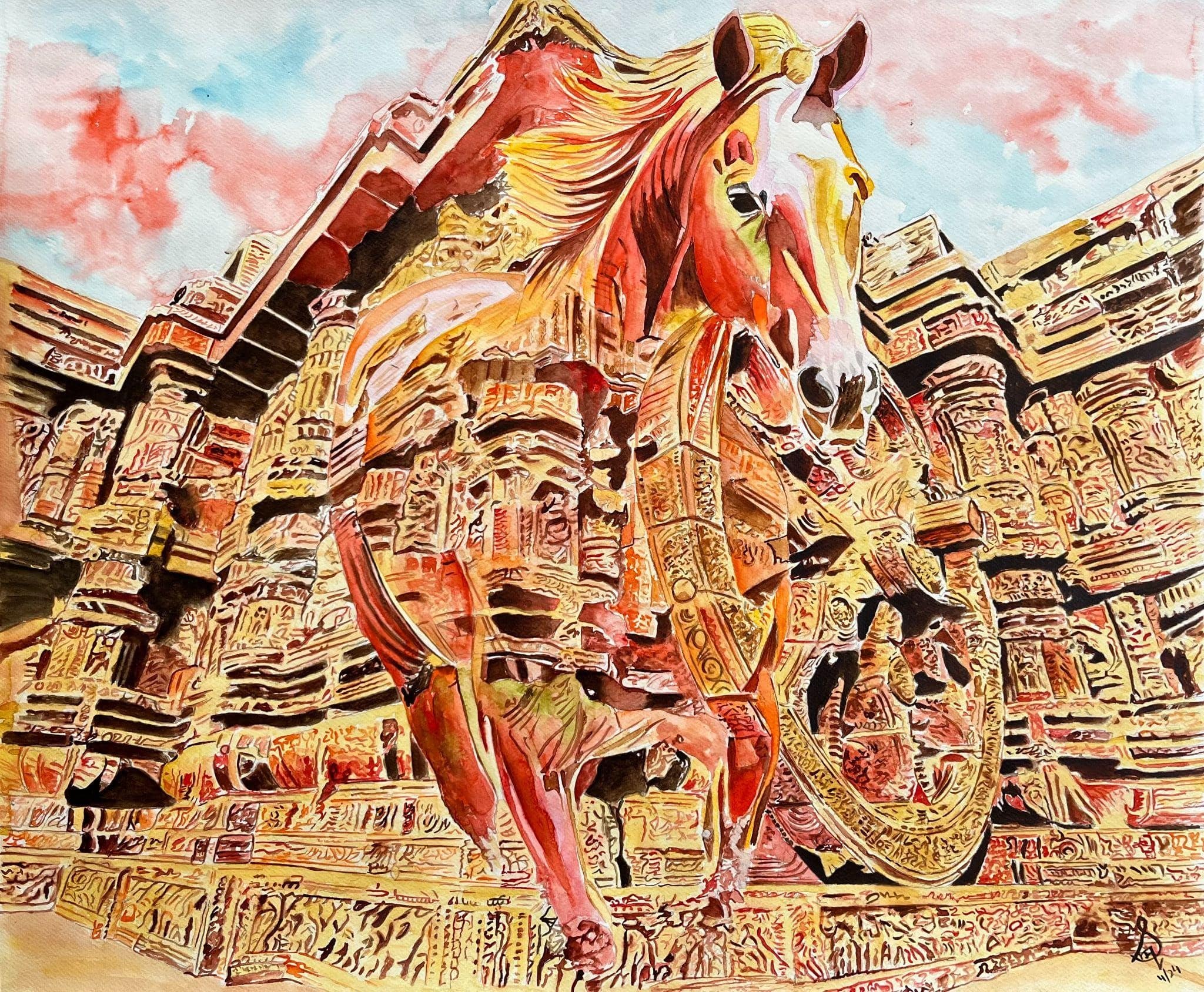
This artwork celebrates the magnificent temple heritage of our country – the chariot of Lord Surya at Konarak is depicted in its full grandeur and the powerful horse represents the seven horses pulling the Sun Chariot. I hope you appreciate the attention to detail in this creation!!
Supratika – The Elephant
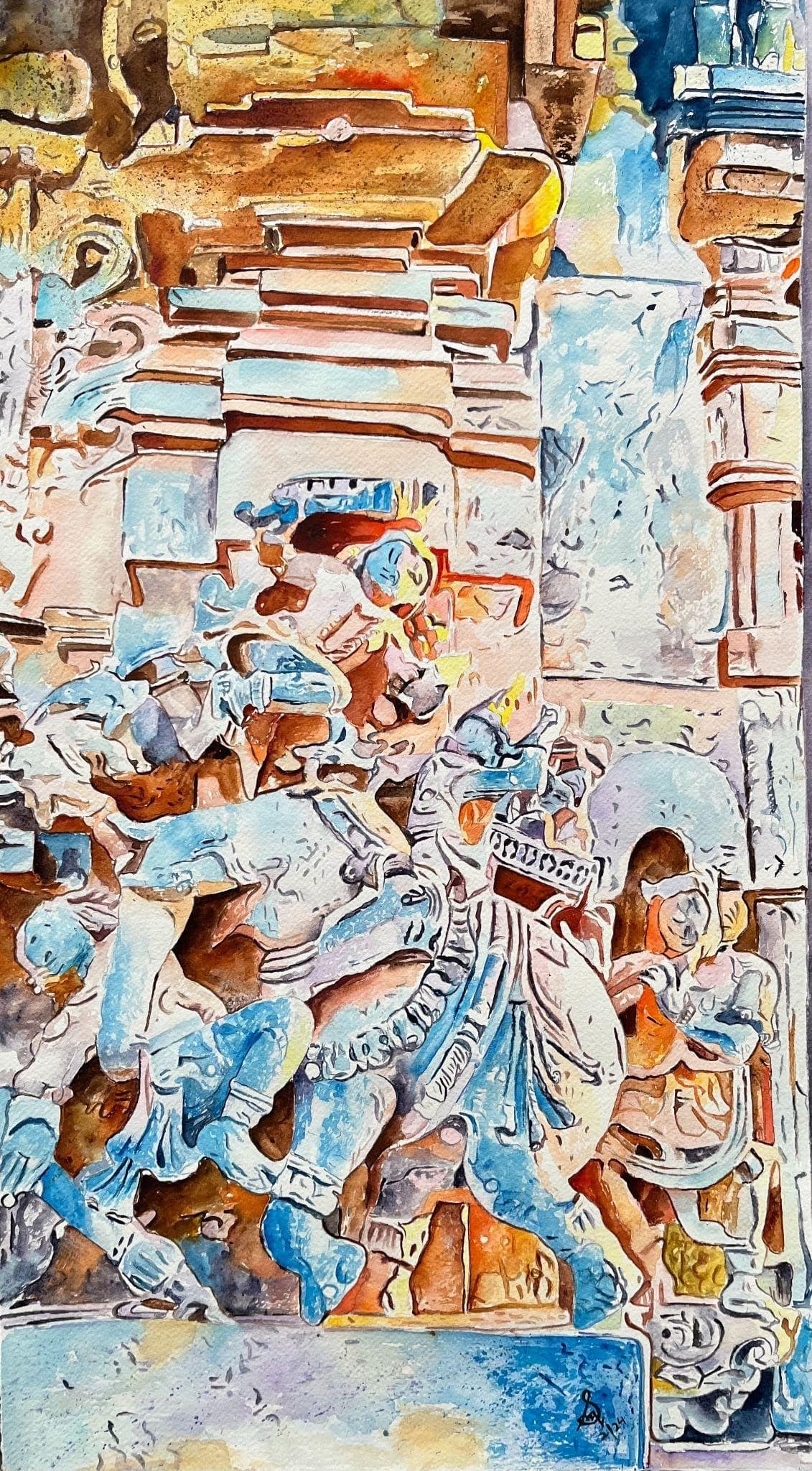
Elephants have been an integral part of our mythology. This artwork depicts the epic battle fought between the mace wielding Bheem and elephant riding Bhagadatta in Kurukshetra. Bheem is in the grip of the trunk of Supratika and can also be seen attacking Bhagadatta with mace from above. This masterpiece of sculpture at Belur temple has inspired this artwork!!
Ananta
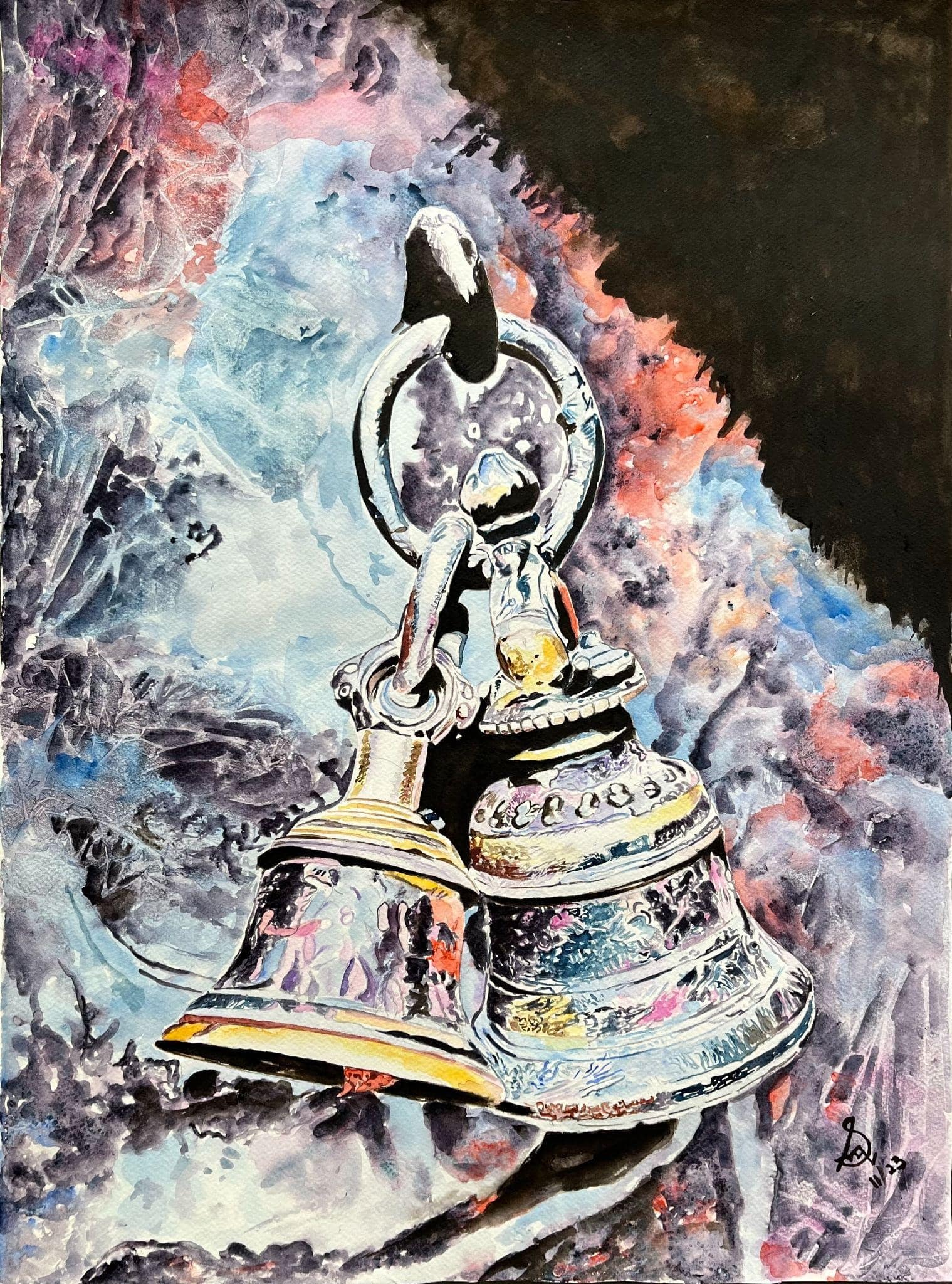
Ananta is what the body of a bell represents- Infinity or Ananta!! This pair of bells is meant to activate the seven Chakras in your body, ward off the negative forces in your life and make you one with the Divine!!
The Dancing Ganesha
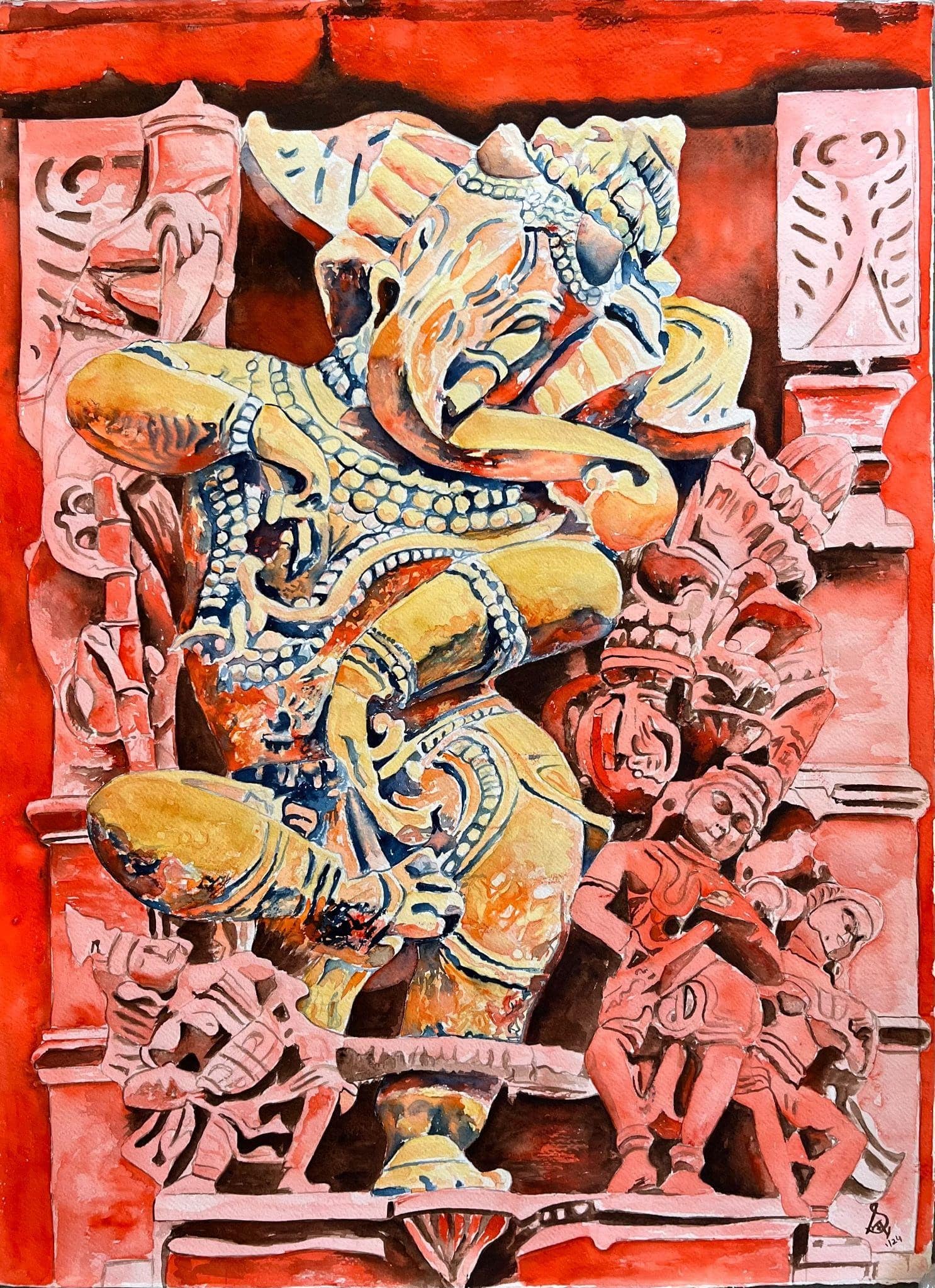
Shiva is the undisputed best dancer in the whole cosmos and here is his son trying to imitate his father!! It’s such a graceful dancing posture with one foot on the ground and the other leg bent and raised. Try appreciating the artistic work in doing those beautiful embellishments!!
In addition to temple art, the exhibition also features captivating landscapes, enchanting depictions of flora and fauna, and influences from European and Cuban architecture. Dr. Mahajan’s ability to transform her experiences and observations into mesmerizing watercolor compositions makes this exhibition a must-see event for art enthusiasts and cultural connoisseurs alike.
Curatorial Note by Dr Alka Pande :
Beauty uplifts, beauty seduces, beauty enhances !! And what could be more beautiful than what one of my favourite poet, William Blake, says about the beauty of that microcosm which constitutes the wondrous world we live in. I see this ethereal beauty abound in the forty watercolours painted by Dr. Sushma Mahajan.
A relentless medium and an unforgiving medium: these form the very core of watercolours or aquarelle. This is the chosen medium of self taught artist, Jaipur based Radiologist, Dr. Sushma Mahajan who, by day, is a committed Medical Professional whilst on holidays and outside the hospital hours, is a passionate artist.
I have been watching Dr. Sushma Mahajan’s artistic journey since its inception during the Covid period. It all started when she started helping out her daughter with her art lessons. The bug of the aquarelle caught her unawares and before she could sense, she was in throes of it with an uncontrollable passion. Dr. Sushma has been painting with a feverish frenzy ever since for the last four years. Beginning with flora and fauna with exquisite delicacy and emotive expression which was the theme of her first solo exhibition in Delhi, Dr. Sushma has now decided to broaden the spectrum and celebrate the beauty all around. ‘This Beautiful World’ is a natural move to explore her own artistic eye. Apart from painting in the earlier genres, Dr. Sushma has added yet another dimension to her painterly oeuvre i.e. Temple Art.
There has been a quantum leap in both style technique and language in the last one year. She has added another dimension to her thematic arsenal – Temple Art. This addition was triggered by a suggestion made by Satpal Maharaj ji, who inaugurated her first Delhi exhibition and asked Sushma to explore the sacred
2
domains as well that led her to try doingTemple Art. Temple Art itself has strong, powerful and sacred interpretation. Temples are situated on sacred geographies. However, Sushma is not looking at the geography but at specifics, magnifying certain elements. She recreates with an unmatched precision the minutest of details from the iconography to the splendid attire and jewellery of the many Gods she has painted. Temple art is complete with highly decorative elements. From the dancing Ganesha to the epitome of primordial masculinity, the richly ornamental Lord Shiva from the Hoysala Temple to the architectural elements of the Chariot Wheel of the famed Virupaksha temple at Hampi, Sushma has painstakingly re-constructed and explored comprehensively the beauty of the world around her. And this naturally led to the title of her forthcoming exhibition – “This Beautiful World”.
Trained as a Radiologist, reading X-ray & CT scans is a daily affair for Sushma. Naturally, her eye over the years developed an X-ray vision to it. She literally went into the micro detailing of expression and contours of forms and shapes in her visual language. From portraits of animals and humans to architectural heritage of India and abroad (which she encountered in her many travels), to vintage cars, Sushma’s colour palette has a distinct earthy palette. From shades of madder to browns with hints of sharp blues and greens, Sushma deploys them all with consummate ease.
The precursor to watercolours or what we know as watercolours in modern form emerged in the frescoes of the Ajanta caves in the 2nd Century A.D. It is interesting to perceive how water based pigments were used to depict religious and everyday scenes in the many wall murals and frescoes of both Nagara /
Northen India and Dravidian / South Indian style temples. In the medieval period, miniature paintings from the Mughal, Rajasthani, Pahadi and Deccan States, water based pigments became the medium of expression.
During the colonial period, watercolor artists from England and Europe i.e. Thomas and William Daniel, Johann Zoffany, William Hodges, James Fraser, Emily Eden loved to visit India to paint. Some prominent themes included the
3
architectural heritage of Varanasi, Madurai and Orissan temples which were produced as commissioned work for British patrons. The medium used for these artworks was watercolour which was one of the most fashionable styles of the period.
We see a flowering of European watercolour techniques in the colonial period. In the transition to the modern period, a very strong art movement in watercolours led by eminent artists such as Abanindranath Tagore and his brother Gaganendranath Tagore popularised water colours in both Kolkata and Shantiniketan. The Bengal School became an apparent source of this powerful movement that played a pivotal role in reviving traditional Indian artistic practices. Artists like Nandalal Bose and Asit Kumar Haldar used watercolours to explore Indian themes and techniques.
Modern Artists in Shantiniketan like K. G. Subramanyan and Benode Behari Mukherjee also popularized watercolours. Along with the influences from China and Japan, the medium of watercolours has an unbroken tradition to present times. Sanjay Bhattacharya and Asit Kumar Haldar employ the versatility and vibrancy of watercolours from Bengal washes to create a distinct language of watercolours.
In contemporary times, Indian artists continue to push the boundaries of watercolour painting, using it to explore diverse themes and styles. Modern watercolourists like Milind Mulick, Samir Mondal and Ananta Mandal have gained recognition for their unique approaches to the medium. They also explore temple themes, portraits and landscapes in their watercolour works, capturing the essence with vibrant colours and innovative techniques. Samir’s works are all imbued with vivid colours representing a sense of vitality and movement that captures the essence of his subjects. Milind Mulick is known for his masterful control over the medium and his ability to capture light and atmosphere in his works. He creates scenes from everyday life, rendered with a delicate balance of detail and spontaneity.
4
Dr. Sushma Mahajan’s work with Watercolours stands apart !! Sushma does not belong to any particular tradition of Indian watercolours – she creates her own ecosystem. She enters the genre through Radiology where she looks at images through micro lens which is her own. She does not study the history of Indian watercolours in a formalized way but has evolved her own personal language, experimenting with aquarelles and initiating a language which is singular and distinct. She has built her own style that has become a rock hard foundation for her creation of hyper real artworks that look more like painted photographs. There is that je ne sais quoi quality to her visual language.
When a dedicated and passionate artist explores a medium, it is a challenge to put a show together. When the mind is bright, alert and full of ideas, the extensive images are difficult to string together in a garland of beauty like a ‘ragamalika.’ In the present exhibition, ‘This Beautiful World’ has three keywords. ‘This’ -which is about the here and now. ‘Beautiful’- which is about beauty, harmony, balance and verisimilitude and ‘World’ – which is Sushma’s inner world. The temporal world is the world inhabited by the objects in which they are situated which involves buildings, people and life as a whole. Sushma delicately combines both her inner and outer world.
It is by connecting the dots between the three words that I developed my conceptual framework to understand, appreciate and bring alive the pleasure of viewing, the delight of making and transferring the ‘rasa’ and ‘bhava’ which would unlock the beauty and aesthetics imbued in each artwork which can stand alone and also be strung together within a composite whole.
Sushma continues to dazzle with her mastery over the medium and transfers her joie de vivre through her water colours.
About Artist
Dr. Sushma Mahajan is a distinguished medical professional and a passionate artist. She completed her MBBS at Lady Hardinge Medical College, New Delhi, and her MD in Radiology from Government Medical College, Patiala. With over two decades of experience, Dr. Mahajan has been a vital part of Bhagwan Mahavir Cancer Hospital in Jaipur for the past 14 years, serving as the Head of Radiology and recently promoted to Director.
Beyond her medical career, Dr. Mahajan discovered her artistic talent during the COVID-19 lockdown in 2020. Self-taught, she embraced watercolor painting, finding it a cathartic escape from her demanding professional life. Her art, characterized by its vibrant and precise realism, often features animals, architecture, and nostalgic vintage items. Dr. Mahajan’s artworks have been showcased in several successful exhibitions, including prominent venues like India Habitat Centre in New Delhi. Her artworks are also displayed in homes of notable figures such as Ajay Shriram, Alok Shriram, Vinita Singhania, and even Princess Diya Kumari of Jaipur, not to mention several suites at the Taj Hotels. Her pieces, which exude positivity and joy, are highly regarded and adorn prestigious households and hotels. Dr. Mahajan aspires to take her art global, continuing to explore and evolve her creative expressions.
About Curator
Dr Alka Pande is an art historian who has taught Indian Arts and Aesthetics at Panjab University for over ten years. Her major interests include gender identity, sexuality, and traditional arts. She has received numerous awards, including the Knight of the Order of Arts and Letters, the Australian-India Council Special Award, and Chandigarh Lalit Kala Akademi honours to mention a few. Pande has also been involved in curating exhibitions and has been awarded the CIMA Lifetime Achievement Award 2023. She is currently the head of the Visual Art Gallery at theIndia Habitat Centre,New Delhi. Dr Pande also set up the Bihar Museum Biennale in 2021 and is now the chief curator for the Bihar Museum Biennale.
Venue: Visual Arts Gallery, India Habitat Centre –
Lodhi Road, New Delhi, Delhi 110003